
Federal Information Security Management Act (FISMA)
Although FISMA doesn’t have specific legal requirements for email disclaimers, it does require federal agencies to implement policies to protect their email systems and ensure the confidentiality, integrity, and availability of information. As such, federal agencies may include email disclaimers to help mitigate risks.
Although FISMA doesn’t have specific legal requirements for email disclaimers, it does require federal agencies to implement policies to protect their email systems and ensure the confidentiality, integrity, and availability of information. As such, federal agencies may include email disclaimers to help mitigate risks.
Federal Rules of Civil Procedure (FRCP)
FRCP rules do not contain any specific requirements for email disclaimers. However, email disclaimers may be included to provide legal protection and set out the terms of use.
Freedom of Information Act (FOIA)
FOIA does not directly apply to private companies, but you may be subject to similar laws that require you to disclose certain information upon request. If you’re sending an email that contains sensitive information, add a disclaimer to inform the recipient that the email is intended for the named recipient only, and that any unauthorized disclosure, copying, or distribution of the email’s contents is prohibited.
FOIA does not directly apply to private companies, but you may be subject to similar laws that require you to disclose certain information upon request. If you’re sending an email that contains sensitive information, add a disclaimer to inform the recipient that the email is intended for the named recipient only, and that any unauthorized disclosure, copying, or distribution of the email’s contents is prohibited.
Gramm-Leach-Bliley Act (GLB)
The GLBA requires financial institutions to implement safeguards to protect email communication. Use email disclaimers to warn recipients that the email may contain sensitive information and should not be shared with unauthorized individuals.
Health Insurance Portability & Accountability Act (HIPAA)
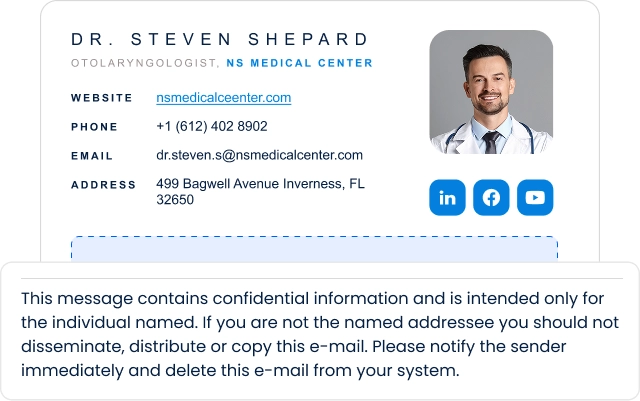
HIPAA-covered entities that use email to transmit protected health information must ensure the confidentiality and security of the information by using email disclaimers amongst other measures.
The Public Information Act, Texas State
PIA requires government agencies to release public information immediately upon request. Email disclaimers may be used to inform recipients that the email communication may be subject to disclosure under PIA
PIA requires government agencies to release public information immediately upon request. Email disclaimers may be used to inform recipients that the email communication may be subject to disclosure under PIA
California Consumer Privacy Act (CCPA)
The CCPA requires businesses to provide certain disclosures regarding personal data processing of California residents. If your company operates in California, use email disclaimers to provide information about your personal data processing in order to limit your liability.
The CCPA requires businesses to provide certain disclosures regarding personal data processing of California residents. If your company operates in California, use email disclaimers to provide information about your personal data processing in order to limit your liability.


